

3 things that will surprise you in thai temples
Sunday 1 February 2026 | Train travel in thailand | thai culture
The beauty of Thailand’s temples is well known. Yet visiting them can be disorienting for Western travelers. Three aspects in particular may unsettle you. Beware of cultural misunderstandings.
The temples you encounter while traveling through Thailand by train display remarkable diversity. Silver, gold, and crystal temples, ancient sanctuaries and contemporary structures: they are countless. In Chiang Mai, for instance—where the new Blue Jasmine train stops—there are around forty major temples within the city itself, and more than 300 across the wider region.
This abundance reflects the central role Buddhist temples—known as wats—play in Thai society. Far beyond religious practice alone, they structure collective life: education, rites of passage, local solidarity, and public ceremonies. Whether in urban centers or rural areas, the temple remains a fundamental point of reference.
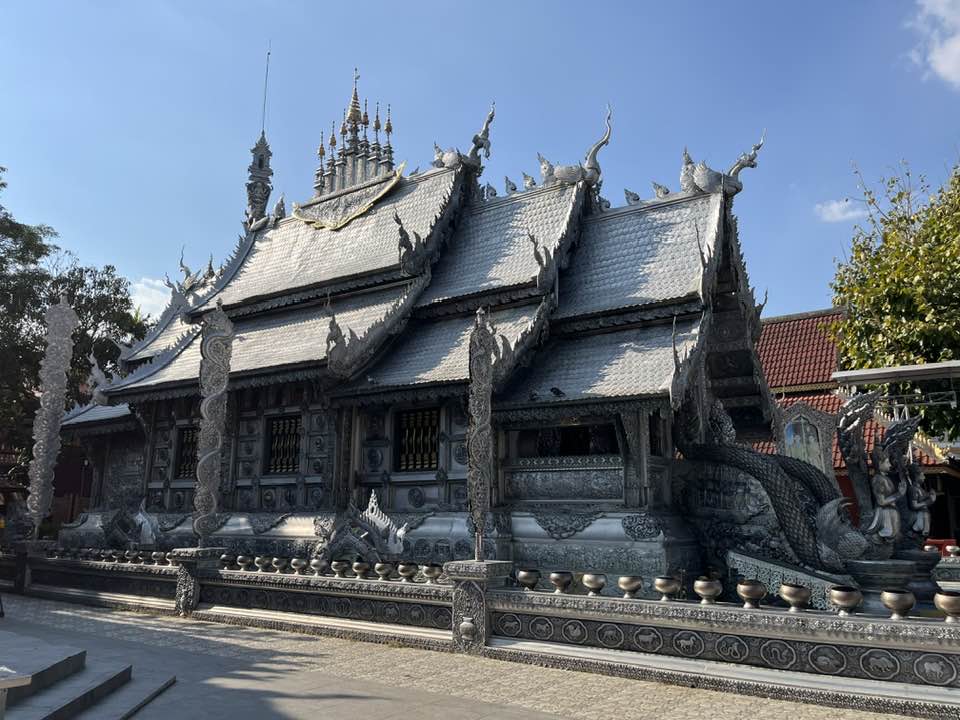
Wat Sri Suphan (Silver Temple), Chiang Mai © Discovery Trains
Monks, for their part, are not seen merely as religious figures. They are regarded as moral reference points. People seek their advice on important decisions, family conflicts, or moments of doubt. Their words carry real social weight, even among those who do not practice Buddhism regularly.
During your journey through Thailand, you will inevitably visit temples. And beyond their architectural beauty, several aspects of how they function—and of the atmosphere that surrounds them—may well surprise you.
1 – Buddhist temples inhabited by… Hindu gods
As Thailand is a predominantly Buddhist country, you enter a temple expecting to encounter statues of the Buddha. And you do—often in large numbers. But not exclusively.
You will also come across deities and spiritual figures that, at first glance, do not seem to belong to Buddhism at all.

Wat Phra That Doi Suthep, near Chiang Mai, houses a sacred relic (a bone of the Buddha). Yet a statue of Ganesha, a Hindu deity, stands very close to its entrance © Discovery Trains
For a Western eye, the most intriguing figures are Hindu deities, and Ganesha in particular. If you have already experienced a train journey in India, you will recognize him immediately: easily identifiable by his elephant head, this Indian god appears very frequently in Thai Buddhist temples.
To understand this coexistence, one has to look back to history. Before the establishment of Theravāda Buddhism, Southeast Asia was deeply shaped by Indianized kingdoms, through trade, diplomacy, and cultural exchange. When Buddhism took hold, these earlier beliefs were not erased; they were absorbed and integrated.
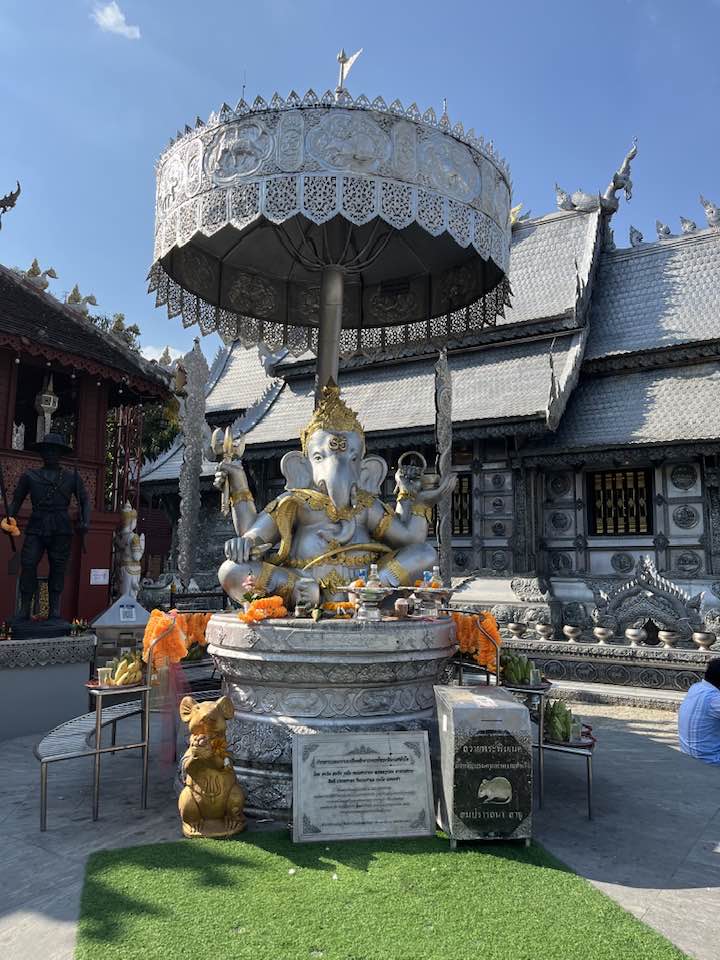
In front of Wat Sri Suphan, the statue of Ganesha stands in majesty beneath its silver chatra, accompanied by his rat, Mushika © Discovery Trains
Even today, Hindu deities are invoked for very specific purposes, complementing Buddhist practice. Ganesha is associated with success, the arts, education, and new ventures. Brahma embodies protection, balance, and stability. This is not a quest for spiritual enlightenment, but a pragmatic appeal to figures believed to help with everyday life.
So do not be surprised to see a student, inside a Buddhist temple, lighting an incense stick before a statue of Ganesha. He is not seeking enlightenment. He is simply hoping to pass his exam.
2 – In Buddhist temples, money is openly discussed
Do money and religion mix well? In the West, we tend to avoid combining the two—at least not too visibly. Merit, in theory, is not measured by the amount one gives. Whether slipping a small coin into the collection box or making a substantial donation, discretion is generally preferred.
In Thailand, the contrast is striking. Donations are very actively encouraged. All kinds of collection boxes—sometimes simple containers, sometimes actual safes—are placed throughout the temple to prompt worshippers to contribute to the needs of religious life.
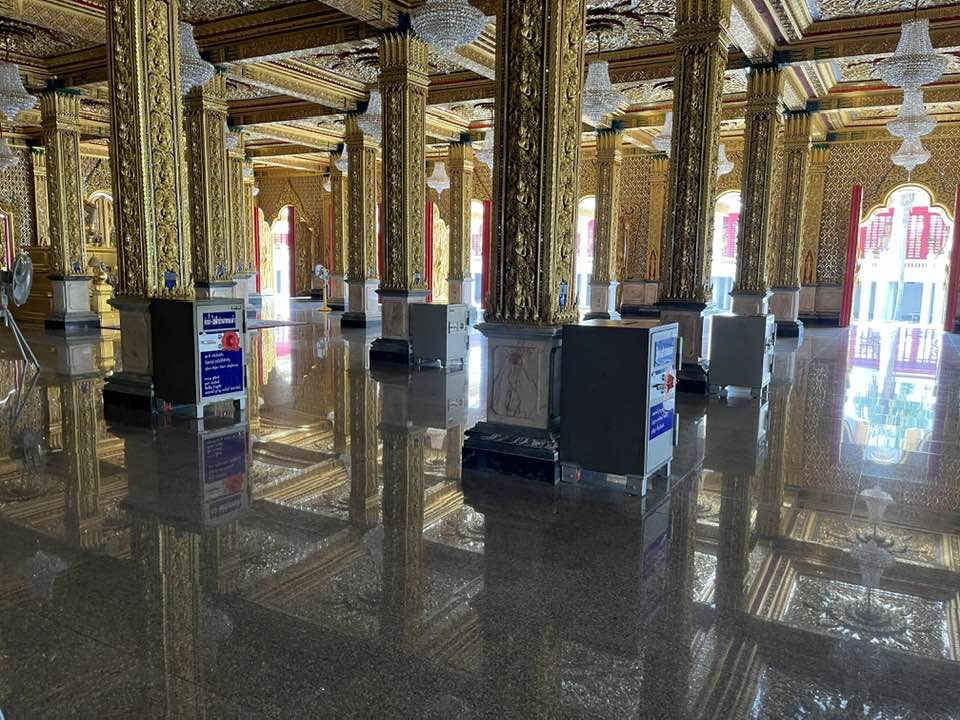
A profusion of safes at Viharn Kaew © Discovery Trains
One example helps clarify this practice. In Thailand, each day of the week is associated with a specific representation of the Buddha. The seven corresponding Buddhas, each shown in a different posture, are usually grouped together in one area of the temple. If you were born on a Tuesday, you would pray before the Buddha of Tuesday, depicted reclining. And you will almost always notice a donation box placed in front of him. You may drop in a coin or a banknote to accompany your prayer, as a way of reinforcing its intention.
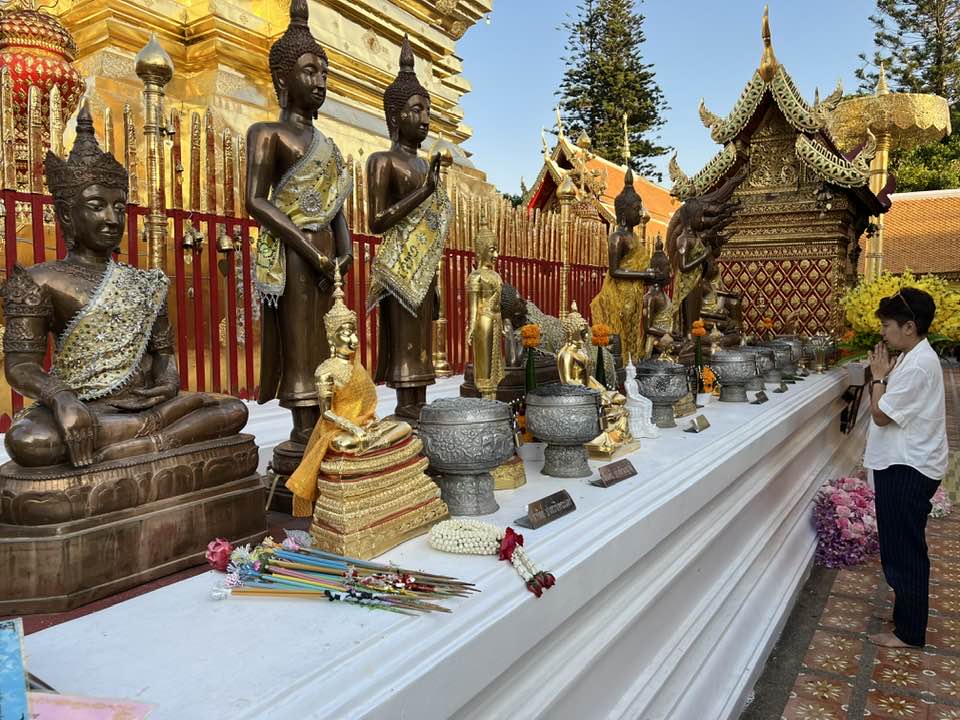
At Phra That Doi Suthep Temple near Chiang Mai, a worshipper prays before the Buddha of her day of birth. She may leave a small offering in the associated silver bowl. © Discovery Trains
Even more surprising to a Western eye, the amounts donated by the most generous contributors are sometimes openly displayed within the temple. Some statues bear the name of the individual or family who financed them. Signs list names and sums, in local currency and sometimes even in US dollars. One may also see garlands of banknotes on display, accompanied by the wishes expressed by the faithful.

At Phra That Doi Suthep Temple, numerous plaques list the names of donors, the dates, and the amounts they have given to the temple. © Discovery Trains
To make sense of this unsettling reality, one must momentarily set aside a Western perspective, which often associates money with a sense of guilt when it enters the religious sphere. In Thailand, this association does not exist. Money given is neither suspect nor impure; it is, by nature, considered positive.

At Phra That Doi Suthep Temple near Chiang Mai, banknotes donated by worshippers are displayed on racks. © Discovery Trains
A donation is seen as a beneficial circulation. It directly contributes to the upkeep of the temple, the daily life of the monks, the welcoming of worshippers, and local acts of solidarity. It therefore benefits the entire community. Making it visible is not a moral failing, but a way of acknowledging its usefulness and impact.
Highlighting a donation is not meant to glorify the donor, but to emphasize the act itself. A name inscribed on a statue or a plaque is a reminder that the temple is a collective endeavor, supported by its faithful. This public recognition encourages generosity and creates a model to follow—whereas in the West, discretion is often upheld as a virtue.
3 – historical heritage is not sacred
Applying shimmering tiles to an ancient sacred site would be almost unthinkable in Europe. Nearly sacrilegious. In the Western imagination, religious practice and the preservation of historical heritage are closely intertwined, to the point where this connection feels self-evident. Yet it is not universal at all.
On closer inspection, this assumption is far from obvious. A temple is, first and foremost, a place for prayer and religious practice, not a museum meant to preserve history or architecture. In fact, the rigid link between the sacred and heritage preservation is not shared worldwide. Thailand reminds you of this constantly.
It is therefore common to see ancient buildings restored with modern materials, or contemporary structures built alongside older ones, without this being perceived as a problem. What matters is not historical authenticity in the Western sense, but the vitality of the place, the intensity of religious practice, and the devotion of the faithful.
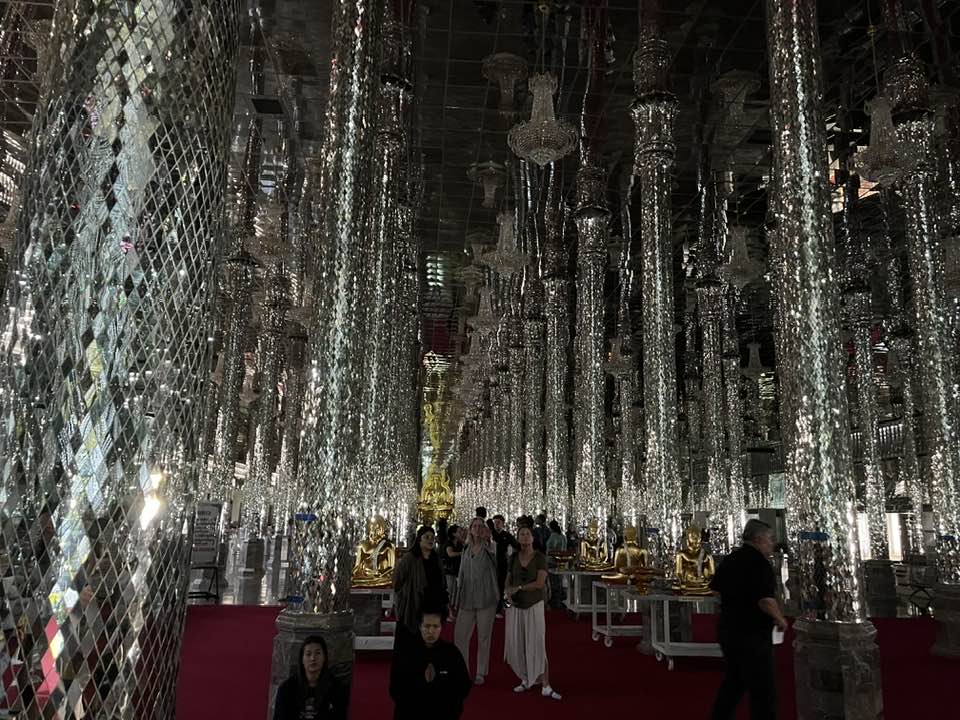
Shimmering mirrors at Wat Tha Sung in Uthai Thani © Discovery Trains
For a Western visitor, this can be disconcerting—even uncomfortable. Seeing inexpensive Buddha statues alongside ancient works. Discovering prayer halls covered in mirrors, stainless steel, or bright modern mosaics can feel unsettling. All of this may give the impression of a lack of respect for the past.
The most striking example is undoubtedly the Silver Temple, Wat Sri Suphan, in Chiang Mai. The earlier structure on the site having been damaged, it was rebuilt in the 20th century and entirely covered in hammered silver by local artisans. From a distance, the effect is impressive.
As you draw closer, you notice an abundance of motifs: scenes from the life of the Buddha, spiritual figures, astrological symbols, elements of the contemporary world, representations of foreign cities…
And then, suddenly, your eye catches an engraving in the silver that looks remarkably like… Marvel’s Avengers. And in fact, it is. The local artist chose to depict Hulk, Iron Man, Captain America, and Spider-Man. For a Western observer, it comes as a shock. And the question inevitably arises: is this temple serious? Is this religion serious? Or am I being led into a kind of cheap, make-believe mini-Disneyland?

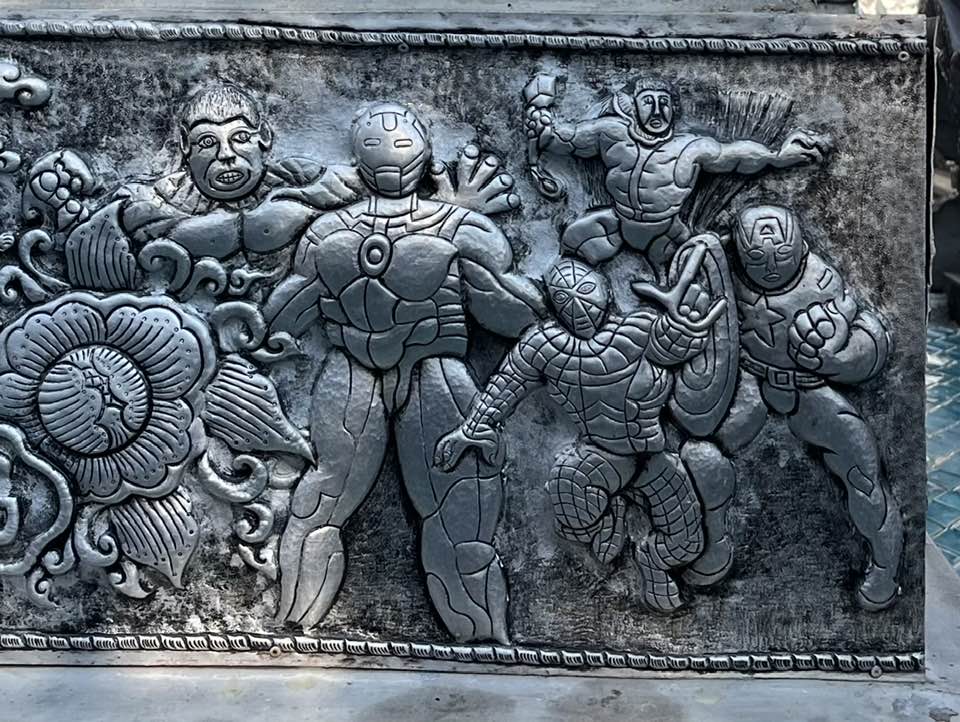
Among the repoussé silver figures at Wat Sri Suphan, Marvel’s Avengers are hidden in plain sight. © Discovery Trains
This, once again, is a cultural misunderstanding.
In Thai tradition, the temple is not a frozen object in time. It absorbs the world as it is, including its contemporary figures.
The Avengers appear alongside monuments and cities from around the world, as an explicit reference to the contemporary West. In this silver frieze, Paris stands next to Moscow; capitals sit alongside myths; Western popular culture becomes just another element of the global landscape. The temple does not rank or judge—it records.
Where the West tends to sanctify the past and draw clear boundaries between religion, popular culture, and heritage, Thailand favors continuity of practice and the integration of the present. What may seem irreverent is not. It is simply another way of keeping the sacred alive.
