

Luxury train tours in Spain
Spain is now the country with the largest number of luxury trains—or high-comfort tourist trains—in the world. Within this exceptional lineup, two stand out clearly as among the most prestigious in Europe: El Transcantábrico and Al Andalus.
Both highly regarded and exceptionally comfortable, each embodies Spanish excellence in rail travel in its own way—so much so that they can legitimately claim the title of the “Spanish Orient Express.”
On this page, discover their key highlights, their distinct styles, and the fares for these truly exceptional trains.
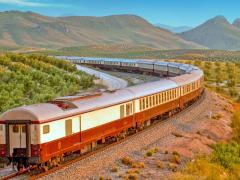
The palaces route (Al Andalus)
LUXURY TRAIN (7 days, 6 nights on board) – From the Moorish splendours of Andalusia to the palaces of Castile, the journey leads you to Madrid, the royal heart of Spain.
Prices from: 7700 €
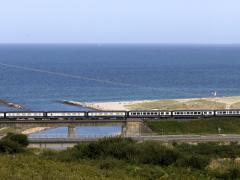
El Transcantabrico (luxury train in northern Spain)
LUXURY TRAIN (8 days, 7 nights on board) Cross Northern Spain to Compostela on El Transcantábrico, Spain's most prestigious luxury train.
Prices from: 8900 €
Do you want to explore Spain by luxury train but aren’t sure which one to choose? It’s worth knowing that Spain is the undisputed champion of special tourist trains. This is a unique case in the world of rail travel: not only are these extraordinary trains numerous and diverse, but they are all operated by RENFE, Spain’s national railway company. Among them, Discovery Trains has selected the two trains that can truly claim luxury train status.
1 – El Transcantábrico: a palace on rails, Spanish style
El Transcantábrico is Spain’s only train officially classified as “Gran Lujo.” That is how RENFE defines this elegant blue-and-white train. It travels through northern Spain from San Sebastián to Santiago de Compostela, via Bilbao, Santander, the villages of the Picos de Europa, Oviedo, and Gijón. The route follows the northern coastline—sometimes called “Green Spain”—from the Basque Country to Galicia.
What sets this luxury train journey apart starts with one essential criterion:
- space. El Transcantábrico is the most spacious of all Spanish luxury trains. Each car has just two cabins, which means exceptionally large private spaces of nearly 13 square meters. If that sounds modest, remember that historic cabins on the famous Venice Simplon-Orient-Express measure around 3 square meters—almost four times smaller. By local comparison, cabins on Al Andalus range from 6.6 square meters (Gran Clase) to 8.3 square meters (Deluxe Suite), nearly half the size.
Another important detail: all cabins on El Transcantábrico are classified as “Grand Luxury Suites.” Whether you choose a double or twin configuration, the size is the same. There is no hierarchy of first or second class—every guest enjoys the same level of comfort.
- El Transcantábrico is also a train that does not “transform” from day to night. On most European luxury trains, the same space serves as a lounge by day and a bedroom by night. While you are dining, your private sitting area is magically converted into a bedroom by the onboard staff. On El Transcantábrico, the cabin is large enough to accommodate both a real bedroom and a true sitting area at all times. The sofa can even serve as an extra bed for a child.
- The generous cabin size naturally limits the number of passengers. With just 14 cars and two cabins per car, there are only about 30 guests onboard, compared to nearly 60 on other Spanish luxury trains. This exclusivity means that reservations are often made more than a year in advance.
- All Spanish luxury trains feature elegant lounge cars, but El Transcantábrico is the only one with a true panoramic observation car. Its large windows—including sections extending into the roof—are reminiscent of Swiss panoramic trains. The windows are cleaned daily, and the seats face outward to maximize views of the Basque Country, Asturias, Cantabria, and Galicia.
- Finally, El Transcantábrico stands out as Spain’s only truly gastronomic train. While meals aboard Al Andalus are also highly appreciated, Transcantábrico’s menus are more elaborate. The train has a large onboard kitchen staffed by an experienced culinary team led by a renowned chef, as well as a refrigerated storage room that allows for daily use of fresh ingredients. As the train travels through northern Spain, the culinary team sources local products and fresh seafood from regional markets. Every meal is a highlight.
The dining cars themselves are elegant, illuminated by stained-glass panels celebrating the Spanish cities served along the historic route—a story the onboard staff is always happy to share.
2 – Al Andalus: Belle Époque charm at the best value
The second best-known luxury train in Spain is Al Andalus. As its name suggests, it traditionally operates in the south and is the luxury train of Andalusia.
Its classic route links the great highlights of the region: Seville, birthplace of flamenco; Córdoba and its mosque-cathedral; Granada and the Alhambra; Ronda perched above its dramatic gorge; Cádiz facing the Atlantic; and Jerez de la Frontera, land of sherry. At every stop, Al Andalus reveals a region where Moorish heritage blends with Baroque Spain, among palaces, cathedrals, and white villages.
In recent years, however, Al Andalus has ventured beyond southern Spain. Each summer, RENFE leases the train to a private operator for a limited number of departures on a north–south crossing of the country, from Seville to Santiago de Compostela. Known as “The Spanish Symphony,” this itinerary traverses Spain vertically and ends in Galicia.
What are the strengths of Al Andalus?
- First and foremost, its Belle Époque spirit. Of all the trains running in Spain, Al Andalus is the most evocative. Its interiors have preserved their original Belle Époque style, with wood paneling, mirrors, and decorative details that immediately recall the atmosphere of the Orient Express.
Other Spanish luxury trains are also historic, featuring authentic Pullman cars, but their interiors do not have the same character. On El Transcantábrico, the décor is more contemporary and comfort-oriented—very pleasant, but less evocative. Aboard Al Andalus, you truly feel as though you are traveling back in time. Successive restorations have preserved the 1920s ambiance while incorporating modern comforts. All cabins—Deluxe doubles or Gran Clase twins—feature private en-suite bathrooms with showers.
- Al Andalus also stands out for its pricing. When comparing Spanish luxury trains, the difference is clear. Both Al Andalus itineraries average around €945 per day: the Andalusian Route (7 days at €6,600, or €943 per day) and the Spanish Symphony (10 days at €9,460, or €946 per day). By comparison, El Transcantábrico 5★ reaches about €1,156 per day for an 8-day journey—nearly 20% more.
Even though El Transcantábrico is slightly more upscale, Al Andalus offers excellent value for money by European luxury train standards.
In short, Spain’s two most luxurious trains also divide the country geographically: El Transcantábrico in the north, Al Andalus in the south. Once a year, however, it is possible to connect southern and northern Spain by luxury train thanks to the “Spanish Symphony” itinerary linking Seville and Santiago de Compostela.
Please note: beyond these two exceptional trains, other RENFE-operated Spanish trains are sometimes presented as luxury trains, such as the Costa Verde Express (a charming train covering part of the Transcantábrico route with a more accessible offering) and the Expreso de La Robla (a vintage-style train with more modest cabins, operating in Castile and León and northwestern Spain at a much lower price).
The Discovery Trains team does not classify these as Spanish luxury trains, but rather as “special trains” with a lower level of luxury. You’ll find them on our page dedicated to train travel in Spain.
